
Overton County Arrest Warrants Explained
An arrest warrant is court process that lets an officer take a person into custody once the required legal showing is made. In Overton County, the local judicial-commissioner resolution spells out how felony arrest warrants issue on probable cause at a law-enforcement request. What it does not supply is a searchable roster. There is no online status form and no published count of active warrants. For records, the Circuit/Criminal Court Clerk is the route, and the Sheriff answers service questions. Call 931-823-5635 for routing help. Do not assume a caller will get live or protected details, though. Ask which court issued the process and whether a public record exists.
Overton County Arrest Warrant Issuance
Overton County's September 2025 resolution cites Tenn. Code Ann. §40-1-111 and puts judicial commissioners in charge of search warrants and felony arrest warrants, issued on probable cause after a law-enforcement request. The same document touches mittimus, bond or release on recognizance, domestic-violence orders, and a pretrial release form. Those are the local mechanics. They do not confirm that any particular warrant is still active. The appointment term in the resolution runs out September 30, 2026. After that date, recheck current county or court materials, since a local resolution is neither a public warrant roster nor a bond schedule. Read the Overton County judicial-commissioner resolution. The document itself supplies the issuance context described here.
Inside an Overton County Arrest Warrant
The public Overton capias form, shown in an official Comptroller exhibit, lays out fields for court, case, count, defendant, bond, appearance, issue date, and the officer's return. No person-specific values appear here. An actual arrest-warrant record may carry different fields depending on the process and the court involved. Ask the Circuit/Criminal Clerk which parts are public and whether a return or later status entry sits in a separate file.
| Court and case | Identifies the issuing court, case number, and count. |
|---|---|
| Process | Shows the type of court command and when it issued. |
| Bond and appearance | May be recorded; no public Overton bond lookup or amount schedule was located. |
| Service return | Can report execution or that the person was not found on an attempt. |
| Status | Ask whether a later recall, quash, or closing entry exists. |
The Overton County form publishes no local number format. A sample case number would just be invented, so use the real case or citation number when you contact the clerk.
Overton County Capias Warrant Schema
A sample capias form helps you name the record fields, but it is not an active-warrant list. The officer return matters most. It can show whether process was executed or only attempted because a person was not found, yet a "returned not found" entry does not mean the court recalled the warrant. Only a later court or agency entry answers that. A narrow request to the Overton County clerk can ask for the process, plus any existing return or status log, for one specified case. The office need not build a countywide index. Ask for inspection or a redacted copy when personal details are unnecessary. The official capias exhibit is useful for field names only; personal values are omitted.
Serving Arrest Warrants in Overton County
The Sheriff's Department is the local contact for execution and custody in Overton County. Its official site lists 1010 John T. Poindexter Drive in Livingston, with phone 931-823-5635. No warrant list or service roster appears there. An officer return may end up in the court file, so ask both the Sheriff and the issuing clerk which status each office can confirm. Jail visitation is a separate matter. The Justice Center visitor-information page sets visitor rules that take planning, but it describes no warrant walk-in schedule.
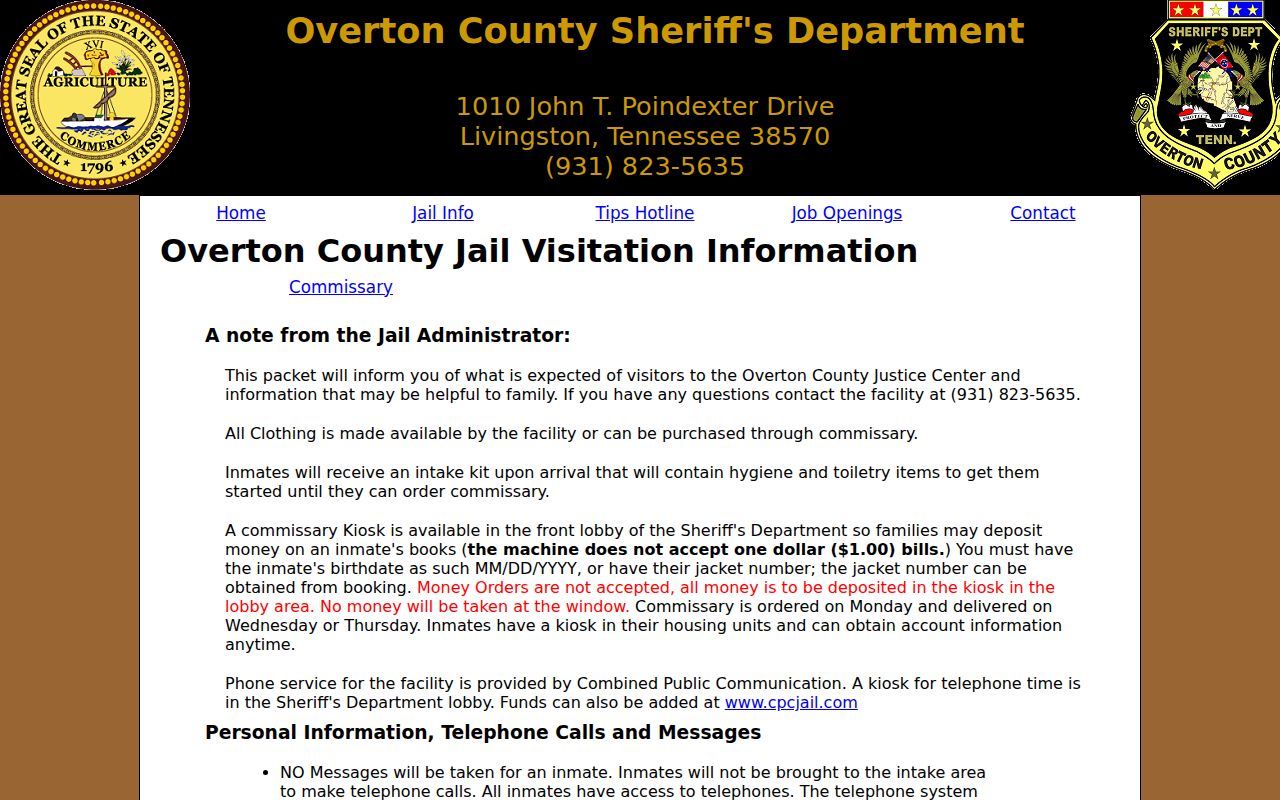
Review the current rules before traveling. No warrant resolution hours were located.
Overton County Arrest-Warrant Service Limits
The Sheriff can be the right contact for execution and custody routing even without a public name-search page. The court clerk holds the case record, while an officer or agency may hold the service return. A quiet website is an access limit, not proof that no file exists and not proof that process is active.
| Office | Likely record role | What to ask |
|---|---|---|
| Circuit/Criminal Clerk | Court file and process | Case, issue, hearing, and later court entries |
| Overton Sheriff | Execution and custody routing | Which office can confirm service or status |
| Livingston City Court | Municipal citations and city process | Whether the paper is a city-court matter |
Ask the Overton County clerk whether a separate General Sessions or municipal counter handles your specific case.
Comparing Arrest, Summons, and Bench Warrants
A summons directs a person to appear. An arrest warrant lets an officer take a person into custody. A bench warrant may follow a missed court date or a failure to comply. Each path creates a different file and a different next step. Tennessee Rules 4 and 9 describe parts of these processes, but the case paper and the issuing court decide which rule applies.
| Process | Usual direction | Overton contact |
|---|---|---|
| Arrest warrant | Take the named person into custody | Criminal/Circuit Clerk and Sheriff |
| Summons | Appear in court | Court printed on the summons |
| Bench warrant | Court process after missed appearance or noncompliance | Court that set the appearance |
Overton County Juvenile Arrest Warrants
Not every file is open to the public. Juvenile matters, sealed records, investigative details, victim information, and protected addresses may be withheld or redacted in Overton County. The Clerk & Master also serves as Juvenile Clerk, yet that office is not the general criminal-warrant counter. Shape a records request around the public document you want, not around protected details. The county Circuit Court Clerk page posts an address, hours, and payment methods, but its clerk name conflicts with the current AOC listing. Before relying on those county details, confirm the name and contact in the AOC Circuit Court Clerk directory or through CTAS.

For Criminal or Circuit Court process in Overton County, start with the current Circuit Court Clerk listing instead.
If There's an Arrest Warrant for You
Call the Overton County court first. Ask for the case number, the process type, your next appearance, and any bond or release instructions, plus the latest status entry. The local offices publish no bond amounts, no walk-in arrest-warrant docket, and no recall form, so the clerk's answer is the record that counts. Talk to a lawyer before you surrender or travel anywhere. Counsel can tell you whether an appearance, a motion, or another step the court allows is safest for your warrant.
Important: Do not act on an old document alone. Confirm current status and required steps with the issuing court, and seek legal advice if needed.
Helping a relative in Overton County works best when they hear it straight from the source. Pass along the official Circuit/Criminal Clerk and Sheriff contacts, and point them to the county warrant overview, which maps out how local resolution gets routed.
Overton County Arrest Warrant Search Limits
Overton County publishes no public arrest-warrant search tool, list, or update schedule. Tennessee offers no single statewide warrant lookup either. The TBI's THOR system exists, but only law enforcement can reach it. The Sheriff will route a question, though phone disclosure is not promised. A written request under the Tennessee Public Records Act can still seek an existing process or return, subject to exemptions. For the court side, the AOC Circuit Court Clerk row names Lori Hammock, with the office at 1000 John T. Poindexter Drive and a listed 931-823-2312 line. The county's own page, still under construction, shows a different name, so confirm the AOC entry before making the trip. Ask that office directly whether it holds both process and return records for an Overton County warrant.